Downsizing Casualties – A form of Professional PTSD?
HR Planning and Strategy courses eventually come around to the distasteful topic of “downsizing”. They talk about “survivors” and politely organic methods of reducing headcounts, like attrition, and smart moves like work redesign and evolution, but there are many times when an organization – rightly or wrongly – just chooses to cut bodies.
For those of us who have been through it, it’s an awful, heart-wrenching experience.
In many cases, we want to be a survivor. We want to be the ones found worthy or valuable and we can continue with the polite fiction of “better them than me”, and “they’ll be OK”. Or we just don’t think about it at all, hunker down, and get our work done, hoping we won’t be next as we look at empty workstations or see stunned staff getting walked out the door.
Don’t kid yourself. It’s hell. It’s one of the things HR professionals and Managers have to deal with and it’s often the result of failure to evolve, manage resources, or make incremental decisions. THIS is the human cost to an organization. THIS is where corporate goodwill takes a significant beating. Yes, I know there’s no obligation to provide jobs for life (Hello, City of Toronto…) I get that. However, the psychological contract people engage in with an organization is not insignificant and one that takes its own beating and we don’t have a word for those who aren’t Survivors.
Corporate divorcee?
Cast-off?
Moved to the organizational “friend zone”?
HR folks…if you’ve achieved your seat at the table you can help influence these decisions. I’m not saying not to reduce headcount. What I am saying is that there are other ways to incrementally and intelligently help Management make the best use of their workforce and their human capital. There is an increasing body of study showing that layoffs or downsizing efforts are counterproductive in the long-term. So…wouldn’t it be nicer for your organization to have a cohesive group that could collectively weather a downturn and take pride in their efforts to bring an organization back to viability?
Don’t leave a string of human casualties in the wake of organizational myopia or inaction. That psychological contract means an awful lot to the folks who are about to be shown the door, whether they admit it or not. Instead, let them become part of the solution instead of feeling like they are part of the problem. Harness that psychological contract for the betterment and transformation.
Think about what kind of organization you might have then…

Video Contribution to #WOLweek
Here is my first iMovie effort and it’s talking about my current work project and some of the challenges we face down the road. Yes, there are some flaws in the video but I had a lot of fun learning the tool and the processes.
I am definitely interested in speaking with Moodle experts about the long-term use/re-use of our learning assets and how we manage resource/assignment updates over their lifecycle. I’d also be interested in speaking with folks who have migrated from Moodle to TotaraLMS.
Jumping in on #wolweek
I’m happy to be a small part of this global effort to increase awareness of Working Out Loud (w.k.a. #WOL) and Showing Your Work.
“Working Out Loud starts with making your work visible in such a way that it might help others. When you do that – when you work in a more open, connected way – you can build a purposeful network that makes you more effective and provides access to more opportunities.”
-John Stepper
I hope to pull together some videos and other resources to share a bit about my ongoing work and share some of the challenges and successes along the way. If you’re a practitioner who wants to learn more about the concepts and possibly join in the fun, check out this blog from Simon Terry. There are some valuable explanations and links to help explain more about Working Out Loud.
Let’s all make some noise about our work!

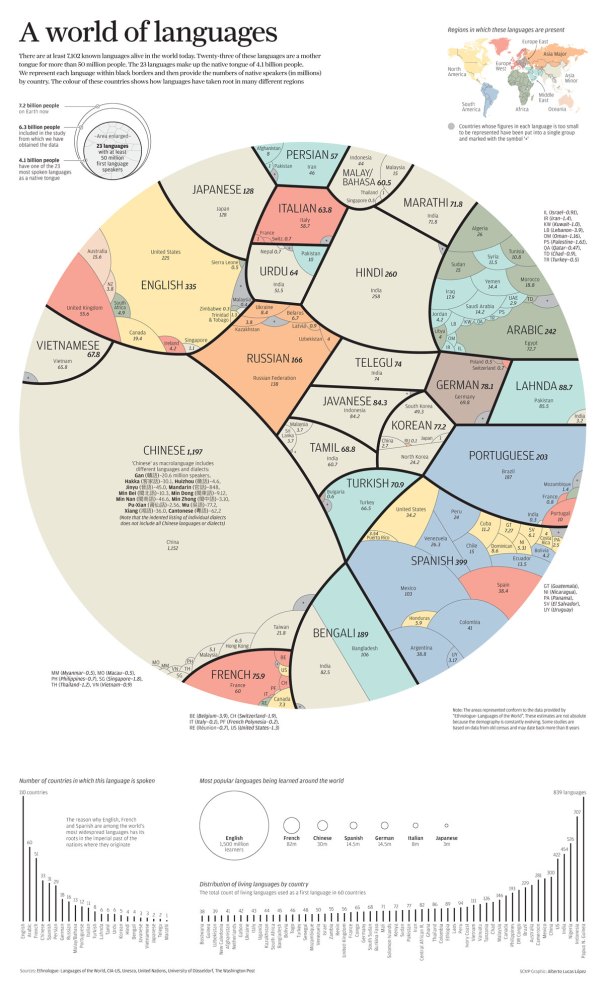
Proportional Pie Chart of the World’s Most Spoken Languages
Infographics are always thought-provoking and this one is no exception. I enjoy seeing numbers relative to population or geography.

“A world of languages” is a fascinating infographic created by Alberto Lucas Lopéz for the South China Morning Post. On his website Lopéz explains:
There are at least 7,102 known languages alive in the world today. Twenty-three of these languages are a mother tongue for more than 50 million people. The 23 languages make up the native tongue of 4.1 billion people. We represent each language within black borders and then provide the numbers of native speakers (in millions) by country. The colour of these countries shows how languages have taken root in many different regions.
The information is based on data from Ethnologue, a comprehensive reference work cataloging all of the world’s known living languages since 1951. To see the full 2000px wide resolution of this pie chart click here.

EduTECH Conference Reflection
I recently had the chance to attend EduTECH in Brisbane as a panelist and speaker on their Workplace Learning track. For those not familiar with this event, it is the largest learning congress in Australia and draws 5000-8000 delegates annually. While most of the participants are in the K-12 and Higher Ed sectors, there is a modest-but-dedicated segment from Workplace Learning and Vocational Training providers and practitioners.
From a professional point of view it was a wonderful experience to be part of, and I was truly humbled to have been invited to share some stories with the delegates and to make connections with genuinely inspired practitioners in another part of the world.
After 2 days of talks and workshops and conversations I have reached a few conclusions about the state of the discipline of L&D, as well as the nature of conferences.
Shared Misery
Most notably, the problems we talk about in the North American sphere are present here in Australasia and also in some parts of Europe. These problems include getting support from orgs, trying new ideas, and strategic engagement. I find the implications of these common problems a little alarming. In that respect, at least, I suppose we are in good company. There is a part of me that wonders whether the global reach of some organizations or their management cultures are the root cause of these shared challenges.
Recurring Messages
Even more alarming is the fact that these problems (breaking down/working across silos, sharing, collaboration, L&D’s role in the business, subvert hierarchies) are ones we see frequently in conferences and even across our social/learning networks. We have also been seeing these problems and the proposed solutions for years. To be honest, I have mixed feelings about this conclusion. On one hand, shared problems should lead to shared solutions. On the other hand, the fact that so many of us continue to experience these issues is rather unsettling.
For example, the conversation about ensuring L&D is aligned with the business isn’t a new one. Not by any stretch. Misalignment is arguably the most worrisome of the problems/challenges listed above and likely contributes to business’ perceptions of the relative value of L&D to the organization. Also consider that we still have to make the argument to support and sustain social learning practices within organizations. Sure, there’s agreement among our peers acknowledging the need, but what are we actually doing about it?
Harold Jarche – in his keynote – continues to share the message about the changing nature of work, how automation of tasks will eliminate roles familiar to us today, and he warns of the increasingly complex environments in which we will find ourselves. I remain unconvinced that we have collectively prepared ourselves for this “brave new world” when we are continually trying to satisfy performance needs with knowledge-based solutions. (Okay, I know, that’s a bit of a blanket indictment but until we can get past living in an IMI 1/IMI 2 world and get past a love of tools that lock us into these kinds of solutions we are going to have a hell of a time moving forward).
Conference meets TEDx
I appreciate the nature of this event for the way in which they approached the sessions. Unlike most conferences I have attended, there were very few workshops or concurrent sessions. Our stream, at least, was in the same room for the duration of the conference (with the exception of the final plenary keynote). They assign a “chair” to each stream ours was Simon Terry) who handles speaker introductions. More than that, they take the time to weave together some of the stories and themes emerging from the talks. That stands in contrast to the usual scene at conferences with attendees scurrying from room to room where there is little time to weave things together. I like to think that the shared space for the duration of the conference helped to create some connections among the delegates because the attendance was less transient.
The speakers abided by the widely-circulated TED principles for their talks. This approach pushes speakers into relating their experience in a story fashion and to think differently than the usual canned presentation. It was also nice that the vendor influence on the talks was very, very minimal. There is nothing more frustrating than to give up your time at a PD event only to have concurrent sessions filled with vendor case studies and talks that are little removed from sales pitches. For me, that kind of thing should reside on the expo floor. There were only 2 sponsor/vendor talks that happened in our stream, but they were mercifully confined to 5 minutes. For what it’s worth, the first of the two was so skilfully done that it did not come across as a vendor talk.
While the format may be somewhat passive consumption, I think the format change for the talks and the approach to the event itself more than compensate for any lack of activity. Personally, I would like to see conference organizers take a very hard look at breaking with the status quo.
Familiar friends in Strange Lands
The best part of any conference is the people. I always appreciate the opportunity to meet new colleagues and other people in my Personal Learning Network (PLN). I got to reconnect with Harold as well as with Shannon Tipton in her new guise as a Learning Rebel. The global nature of networks also means that you will wind up meeting local people in far-off places, like fellow Canadians George & Alec Couros. At long last, I met Steve Wheeler from the UK and the influential K-12 blogger and tweeter, Shelly Sanchez Tyrell. Also great to meet Amy Rouse from AT&T U, who isn’t terribly active on Twitter but does some amazing stuff with in-house MOOCs. Of course our hosts were a fantastic crew of Australians. I appreciated the opportunity to meet Ryan Tracey, Joyce Seitzinger, Michelle Ockers, Con Ongarezos, and many, many others.

EduTECH 2015 Workplace Learning Speakers L-R: Simon G. Terry (moderator), Amy Rouse (AT&T U), Harold Jarche (ITA), Me, Joyce Seitzinger (adademictribe), Shannon Tipton (Learning Rebels), Ryan Tracey (AMP), Michelle Ockers (Coca-Cola Amatil). Not pictured: Alec Couros, David Price, Peter Baines, Con Ongarezos. (photo credit Mairi Thomson @OpenAccessLearn)
Final Thoughts
There is a lot of talk about breaking with the status quo and working to improve our influence and reaching within our organizations. The best way those things will happen is from within. Organizations like mine are rare where empowerment and autonomy are core principles. Not everyone is lucky enough to work for a Zappos, or a Virgin Group, or a Northern Lights where these principles are on display. To that end, our own professional development and critical thinking should take on greater importance. It doesn’t matter if it’s a chat, or a MOOC or forming an alliance with trusted practitioners. If you’re talking, you’re sharing. If your listening, you’re learning.
…and if you’re learning, you’re on your way to keeping us all relevant and cementing your own role in a new world for L&D.
My Guest Blog for Learning Rebels on ATD ICE and the Backchannel
From Shannon Tipton, the Learning Rebel
Not Attending ATD ICE? The Backchannel Saves the Day
I’ll be there! Oh, shucks – you won’t be? I’m truly sorry to have missed you. (Cue sad face)
A close network friend of mine won’t be there either. (Cue another sad face)
But won’t he? He will be there in spirit. In the Backchannel. That’s the beauty of technology these days, we can be anywhere and pretty much have a front row seat. I asked Mark to give me his insights as to how he will be participating from afar and his advice on making use of the backchannel.
via Guest Blogger, Mark Sheppard: Not Attending ATD ICE? The Backchannel Saves the Day – Learning Rebels.

3 Characteristics of High Impact Learning Departments: Laura Overton Interview | Totara LMS
3 Characteristics of High Impact Learning Departments: Laura Overton Interview
March 18, 2015
[Steve Rayson] I really like data, whilst I am interested in someone’s views I am particularly interested in evidence and insights based on data. Thus I was excited this week to catch up with Laura Overton. Laura is the MD at Towards Maturity and runs one of the largest corporate learning data collection projects.
via 3 Characteristics of High Impact Learning Departments: Laura Overton Interview | Totara LMS.
My Take: Laura boils departmental success down to 3 key factors based on research and analysis across a number of L&D professionals. What’s important to note, at least for me, is that these three points are not new. They should not be earth-shattering revelations for anyone. I think what is really disturbing is that we have to keep saying it (particularly point #3) and that we need the research to back it up.

Will at Work Learning: Net Promoter Score — Maybe Fine for Marketing, Stupid for Training
From Will Thalheimer…
More and more training departments are considering the use of the Net Promoter Score as a question–or the central question–on their smile sheets.
This is one of the stupidest ideas yet for smile sheets, but I understand the impetus–traditional smile sheets provide poor information. In this blog post I am going to try and put a finely-honed dagger through the heart of this idea.
via Will at Work Learning: Net Promoter Score — Maybe Fine for Marketing, Stupid for Training.
My take: something done poorly is best not done at all…and that sums up most of my feeling on the use of smiley sheets as the sole measure of “training success”. I recall my days as a MCSE / MCT for a major corporate training provider here in Canada. Microsoft Curriculum demanded a feedback form after every class. We were even supposed to send them to MS Canada, but apparently even they didn’t bother looking at them in detail. However, woe betide any MCT who didn’t score highly. As for me? I was less concerned about the numerical scores. I used to tell my students, “a 5 or 6 out of 7 with some comments about what you feel needs improvement is of much more value to me than a 7 out of 7 with no comments at all.”
As time has gone on, I have fallen further away from Kirkpatrick’s model (Dan Pontefract’s comments on it notwithstanding) and I prefer to use other methods for evaluation. Will is very interested in “mythbusting” in the L&D space and this post is another example of some of the practices that persist in L&D – to our collective detriment.

Millennials: Entitled? Job hoppers? We Think Not
Here is an article from Debbie Landers who is the General Manager, Kenexa & Smarter Workforce at IBM that you should find very interesting as we are seeing an influx of Millenials coming into the workforce. According to the numbers Millenials will make up 50% of the workforce by 2020 so getting a grounded understanding of who they are is definitely important.
A new study by IBM’s Institute for Business Value, Myths, exaggerations and uncomfortable truths, has busted numerous myths typically associated with Millennials at the workplace.
via The Millennials: Entitled? Job hoppers? We Think Not. – The Human Resources Social Network.
My take: While there are a few questionable assumptions in this article (Digital Natives, Generational Learners, etc.) I feel it important that we have sufficient empathy for the diverse nature of our learner community. Needs, wants, motivations, and goals, will be different for all.
Share your thoughts on the myths busted in the study. Did the study go too far? Or not far enough?

 The Hitch Hiker's Guide to Learning

Helicopter parenting and college-age depression/anxiety
Jul 9
Posted by Mark L. Sheppard
via Helicopter parenting is increasingly correlated with college-age depression and anxiety..
My take: I see huge implications on the immediate-future workforce. The kinds of post-secondary students referenced in the book have poor executive function and critical thinking skills. What I see are larger implications for the longer-term future as these traits get passed on to the next generation. So the Slate.com article raises the question about what could be done to stem this tide.
I wasn’t raised by helicopter parents, but inherited anxiety issues left me afraid to fail for a long time. Now, it’s a lot less of a concern because I see failure as part of the “new ideas” cycle. So many people forget that failure is also learning so we do our kids (and, by extension, our learners) a huge disservice by not allowing them to fail (safely). If you’re afraid to fail, you won’t take risks. Risk-taking is part of Innovation. Without innovation, we see people living in the “we’ve always done it that way” world and, well, we know what that’s like.
Let’s start by enabling safe-fail environments and some reinforcement of executive function and critical thinking. We might be able to get a head-start in the workplace while the Higher Ed institutions try the same things at their end.
Posted in commentary, reblog
4 Comments
Tags: anxiety, book excerpt, future workforce, Mental Health, parenting, slate.com, Workplace Insiders, workplace learning